Data spaces in Stellio
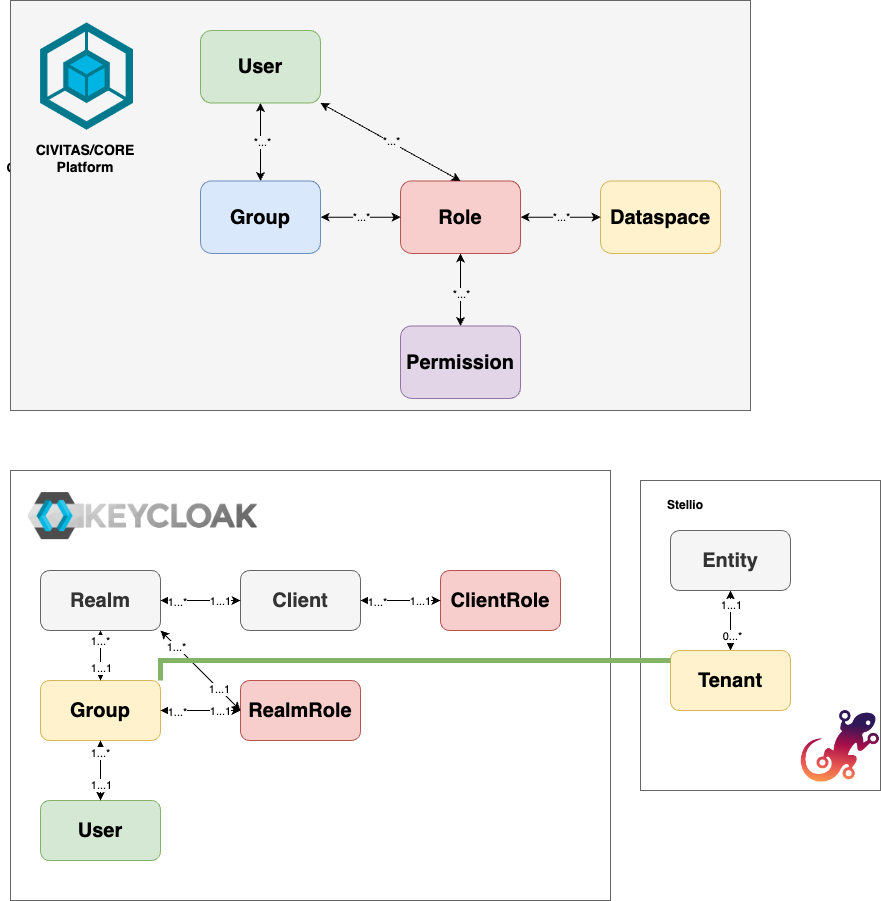
To configure the data spaceData spaceA thematic area that contains specific data and resources in different platform components. Data is stored in exactly one data space, and access rights are specific to each data space. Roles within a data space control what users and groups can do in it. model in StellioStellioAn NGSI-LD compatible context broker. On the platform, a data space maps to a tenant in Stellio with separate roles for reading, writing, and deleting entities., we group the key entities of StellioStellioAn NGSI-LD compatible context broker. On the platform, a data space maps to a tenant in Stellio with separate roles for reading, writing, and deleting entities. into Tenants.
Access checks are handled by the API Management in front of StellioStellioAn NGSI-LD compatible context broker. On the platform, a data space maps to a tenant in Stellio with separate roles for reading, writing, and deleting entities., similar to other components in the CIVITAS/CORE Platform.
How the Platform's Data space Concept Maps to Stellio
For each data spaceData spaceA thematic area that contains specific data and resources in different platform components. Data is stored in exactly one data space, and access rights are specific to each data space. Roles within a data space control what users and groups can do in it., we implement a Tenant in StellioStellioAn NGSI-LD compatible context broker. On the platform, a data space maps to a tenant in Stellio with separate roles for reading, writing, and deleting entities. with a set of three needed Roles for Reading, Writing and Deleting entities. The API Management checks if the required role is assigned to the user.
- Entities: Entities are the core data objects in StellioStellioAn NGSI-LD compatible context broker. On the platform, a data space maps to a tenant in Stellio with separate roles for reading, writing, and deleting entities.. Entities are assigned to tenants, and stored in tenants.
- Tenant: A tenant is a grouping of entities where access to the tenant can be granted. The integrated check of StellioStellioAn NGSI-LD compatible context broker. On the platform, a data space maps to a tenant in Stellio with separate roles for reading, writing, and deleting entities. is disabled and replaced by the API Management in front. Tenants are separated schemas on database level.
Example for Keycloak and Stellio
The following settings describe the data spacesData spaceA thematic area that contains specific data and resources in different platform components. Data is stored in exactly one data space, and access rights are specific to each data space. Roles within a data space control what users and groups can do in it. named "baumkataster" and "denkmalschutz" defined in KeycloakKeycloakThe component that manages access to data spaces across all platform components. It uses realms, clients, roles, users, and groups, and represents each data space through specific roles. and StellioStellioAn NGSI-LD compatible context broker. On the platform, a data space maps to a tenant in Stellio with separate roles for reading, writing, and deleting entities.:
KeycloakKeycloakThe component that manages access to data spaces across all platform components. It uses realms, clients, roles, users, and groups, and represents each data space through specific roles. client "api-access":
- Group for data spaceData spaceA thematic area that contains specific data and resources in different platform components. Data is stored in exactly one data space, and access rights are specific to each data space. Roles within a data space control what users and groups can do in it. "baumkataster":
baumkataster - Group for data spaceData spaceA thematic area that contains specific data and resources in different platform components. Data is stored in exactly one data space, and access rights are specific to each data space. Roles within a data space control what users and groups can do in it. "denkmalschutz":
denkmalschutz - KeycloakKeycloakThe component that manages access to data spaces across all platform components. It uses realms, clients, roles, users, and groups, and represents each data space through specific roles. user "Max Mustermann" (
max@mustermann.de)- User-Group-Assignments:
baumkataster,denkmalschutz
- User-Group-Assignments:
- Tenants in StellioStellioAn NGSI-LD compatible context broker. On the platform, a data space maps to a tenant in Stellio with separate roles for reading, writing, and deleting entities.:
baumkataster,denkmalschutz
Mapping illustrated
The mapping is illustrated in the following image, using matching colors for corresponding objects.
Setting Up Data spaces in Stellio
During deployment, the data spacesData spaceA thematic area that contains specific data and resources in different platform components. Data is stored in exactly one data space, and access rights are specific to each data space. Roles within a data space control what users and groups can do in it. configured in inv_access.additional_dataspaces will be picked up and created as tenants in StellioStellioAn NGSI-LD compatible context broker. On the platform, a data space maps to a tenant in Stellio with separate roles for reading, writing, and deleting entities.. Creation of tenants during runtime is currently not supported by StellioStellioAn NGSI-LD compatible context broker. On the platform, a data space maps to a tenant in Stellio with separate roles for reading, writing, and deleting entities..
inv_access:
  ...
  additional_dataspaces:
    - "ds_traffic"
    - "ds_energy"
    - ...